
SP VirTis AdVantage Pro freeze-dryer
A key tool enabling advanced sample preparation and high‑quality results
Freeze drying
Freeze drying allows materials to be dried without structural collapse, enabling the development of porous, lightweight, and high performance products such as aerogels and advanced fiber structures. Our expertise and laboratory equipment give industry partners the ability to test ideas quickly, reduce risk, and obtain reliable results without investing in their own infrastructure.
Read more
SP VirTis AdVantage Pro Freeze Dryer
Our SP VirTis AdVantage Pro Freeze Dryer is well suited for drying porous biomaterials, where preservation of microstructure is critical.
Read more
Contact: Ingebjørg Leirset, Merete Wiig
Do you want to create high-performance, porous biomaterials without compromising their structure?
Freeze drying allows materials to be dried without structural collapse, enabling the development of porous, lightweight, and high performance products such as aerogels and advanced fiber structures. Our expertise and laboratory equipment give industry partners the ability to test ideas quickly, reduce risk, and obtain reliable results without investing in their own infrastructure.
As sustainability, resource efficiency and green innovation become increasingly important, drying technology plays a key role in developing new bio-based products. Cellulose, lignocellulose and other fiber rich biomaterials are complex, porous and highly sensitive to drying conditions. Traditional drying methods can lead to pore collapse, agglomeration, changes in fiber architecture and loss of functional properties. Freeze drying takes place at low temperatures and low pressure, where water is removed directly from ice to vapor through sublimation.
Our SP VirTis AdVantage Pro Freeze Dryer is well suited for drying porous biomaterials, where preservation of microstructure is critical. Its precise control of shelf temperature and vacuum enables gentle sublimation, minimizing collapse or shrinkage of delicate pore networks. In hydrogels and aerogels, stepwise control of freezing temperature and freezing rate allows modulation of pore size and orientation through ice templating. Combined with programmable freezing rates, advanced endpoint detection, and uniform shelf heating, the system provides consistent, reproducible results across samples – ideal for both research and industrial development.
The freeze dryer is part of the infrastructure NORCELlab (The Norwegian Cellulose Laboratory). NORCELlab is owned by RISE PFI and funded by the Research Council of Norway.
Read more about NORCELlab here.
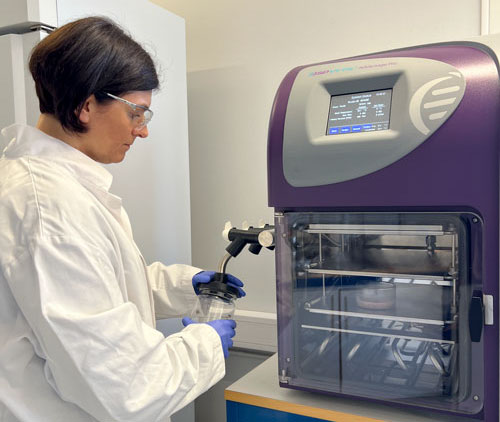
Our senior engineer Merete Wiig is working on the freeze dryer